

India’s culinary history is deeply intertwined with geography, climate, and royal ingenuity. Some foods were born out of abundance; others emerged from necessity. Bikaner Bhujia belongs firmly to the latter- an iconic snack that originated not from luxury, but from resilience in one of India’s harshest landscapes.
What began as a humble desert preparation has today become a household staple across India and an internationally recognised savoury. Yet, behind its unmistakable crunch lies a story of royal patronage, desert survival, migration, and enterprise- a story that continues to define the cultural identity of Bikaner.
Bikaner: The Desert That Shaped Its Food
To understand Bhujia, one must first understand Bikaner.

Situated on the edge of the Thar Desert, Bikaner has historically faced extreme heat, minimal rainfall, and limited agricultural diversity. Fresh vegetables were seasonal. Preservation was not optional-it was survival.
The local cuisine evolved accordingly:
- Foods that could last weeks without refrigeration
- Ingredients that required minimal water
- Recipes that relied on spices, gram flour, and lentils
- Techniques that prioritised drying, frying, and roasting
In this environment, snacks were not indulgences; they were nutritional insurance. Bhujia was born from this reality.
The Royal Roots of Bikaner Bhujia
The story of Bikaner Bhujia begins in the late 19th century, during the reign of Maharaja Dungar Singh of Bikaner.

Unlike many royal delicacies reserved for banquets, Bhujia was created as a functional food:
- Easy to prepare in large quantities
- Long shelf life for desert travel
- Light yet energy-dense
- Affordable for soldiers and commoners alike
The innovation lay in the use of moth dal (a hardy desert legume) blended with gram flour and spices, extruded into thin strands and deep-fried to achieve maximum crunch with minimal oil absorption.
Initially, Bhujia was not sold commercially. It was prepared in royal kitchens and local homes, shared during festivals, journeys, and military movements.
From Palace Kitchens to Bazaar Counters
As trade routes expanded and railways connected Bikaner to the rest of India, Bhujia began its journey beyond the city walls.
Local merchants recognised three critical advantages:
- Shelf stability – no spoilage during long journeys
- Scalability – easy to produce in bulk
- Universal appeal – spicy, crunchy, addictive
Small family-run shops began preparing Bhujia using guarded recipes. Over time, these shops became institutions, and Bikaner slowly earned its reputation as India’s namkeen capital.
By the early 20th century, “Bikaner Bhujia” was no longer just a product-it was a geographical identity marker, much like Darjeeling tea or Kolhapuri chappals.
What Makes Authentic Bikaner Bhujia Different
Despite countless variations available today, authentic Bikaner Bhujia is defined by a few non-negotiable elements:
Moth Dal Base
Unlike regular sev made primarily from gram flour, Bikaneri Bhujia uses moth beans, which give it:

- A distinct earthy flavour
- Crispness without heaviness
- Better digestibility
Fine Extrusion
The strands are thinner than standard sev, ensuring:
- Even frying
- Light texture
- Higher crunch-to-oil ratio
Balanced Spice Profile
Spice is present but controlled. The focus is aroma and warmth, not heat.
Dry Desert Frying Technique
Traditionally fried in smaller batches to prevent moisture retention-essential in a humid-free desert climate.
These details are why Bhujia made outside Bikaner rarely tastes the same.
Varieties of Bhujia: Tradition Meets Taste Evolution
Bhujia has never been a one-note snack. While its roots remain firmly traditional, its versatility has allowed multiple variants to emerge-each catering to distinct palates without compromising the essence of the original product.
Plain Bhujia
Plain Bhujia represents the purest expression of this iconic snack. Made primarily from chickpea flour and a restrained blend of spices, it delivers a balanced, earthy flavour with a clean finish. This variety highlights texture and technique over spice intensity, making it a timeless everyday accompaniment to meals or tea.
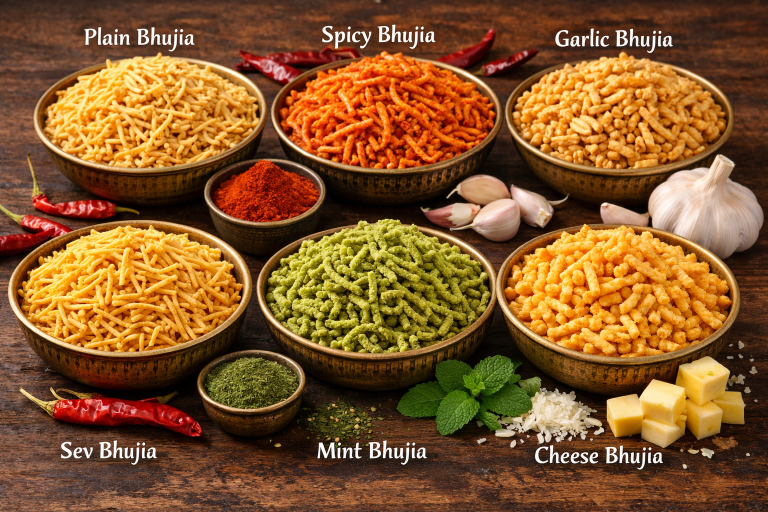
Spicy Bhujia
Spicy Bhujia is crafted for consumers who prefer a pronounced heat profile. Enhanced with additional red chilli powder and robust spices, it offers a sharper, lingering bite. Despite the heat, a well-made spicy Bhujia maintains balance, ensuring spice elevates the snack rather than overpowering it.
Sev Bhujia
Sev Bhujia blends two classic formats into one cohesive snack. The thinner sev strands provide an extra-light crunch, while the seasoning mirrors traditional Bhujia flavours. This variety is particularly popular as a topping for chaats, bhels or eaten standalone for its crisp, melt-in-the-mouth texture.
Mint Bhujia
Mint Bhujia is a contemporary interpretation designed for a refreshing flavour experience. Infused with dried or powdered mint, it delivers a cooling contrast to the natural spice base. The result is aromatic, mildly tangy, and especially appealing during warmer seasons.
Garlic Bhujia
Garlic Bhujia caters to consumers seeking bold, savoury depth. The addition of garlic-either powdered or paste-based-adds richness and a lingering umami note. This variant is heavier on flavour and pairs well with beverages, making it a preferred choice for evening snacking.
Cheese Bhujia
Cheese Bhujia reflects modern fusion snacking trends. By integrating cheese seasoning with traditional Bhujia spices, it creates a creamy-salty profile layered over the familiar crunch. While unconventional, it appeals strongly to younger audiences and urban markets seeking indulgent flavours.
Migration, Branding, and the National Spread
The next phase of Bhujia’s evolution came through migration.
Business families from Bikaner moved to Kolkata, Mumbai, Delhi, and later overseas. They carried with them:
- Recipes
- Techniques
- The credibility of origin
Over time, Bikaner Bhujia transitioned from loose snack to branded packaged product, entering modern retail, exports, and e-commerce.
However, commercialization also created challenges:
- Dilution of recipes
- Over-spicing for mass markets
- Replacement of moth dal with cheaper alternatives
This has made authenticity more valuable than ever.
Bikaner Bhujia as Cultural Heritage
Today, Bhujia is not merely eaten-it is gifted, travelled with, and remembered.
For many:
- It is the taste of childhood train journeys
- A compulsory stop while visiting Bikaner
- A symbol of Rajasthani hospitality
Culinary historians increasingly regard Bikaner Bhujia as an example of intangible cultural heritage-a recipe shaped by climate, community, and continuity.
Experiencing Bikaner Beyond the Plate
For travellers, tasting Bhujia in Bikaner is part of a larger narrative:
- Walking through old bazaars
- Understanding desert life
- Experiencing fort architecture and royal kitchens
- Observing how food adapts to geography
This is where heritage hospitality plays a critical role-connecting cuisine with context, not just consumption.
Why the Story of Bhujia Still Matters
In an age of fast food and short attention spans, Bikaner Bhujia stands as a reminder that:
- Great food does not need luxury origins
- Constraints often fuel the best innovation
- Local knowledge can create global impact
Its story mirrors Bikaner itself-resilient, understated, and enduring.
Final Thought
Bikaner Bhujia is not just a snack.
It is a desert solution turned national obsession, a royal experiment turned people’s favourite, and a reminder that India’s most powerful stories are often hidden in everyday flavours.
For those who travel with curiosity, the crunch of Bhujia carries centuries of history-waiting to be heard.